Small Area Estimation for UK Local Authorities#
Borrowing strength when the sample runs out
A Fay–Herriot area-level model for APS unemployment rates, compared with ONS’s published model-based estimates
Project Overview#
Direct survey estimates of unemployment become too volatile to publish once the Annual Population Survey is broken down to local authorities: the numerator sample is often a handful of unemployed people. ONS has long addressed this with model-based estimates that borrow strength from the claimant count. This project is an open-source reimplementation of that class of model — classical EBLUP and a Bayesian hierarchical version — validated against the Nomis-published official series.
The analysis uses only openly licensed aggregates (no Accredited Researcher / SDS access). Sampling variances \(\psi_i\) are recovered from published 95% confidence intervals. The linking model is the textbook Fay–Herriot specification: a linear mean in the claimant-count rate and iid area random effects.
Project Structure#
Six notebooks build the analysis step by step:
Key Questions#
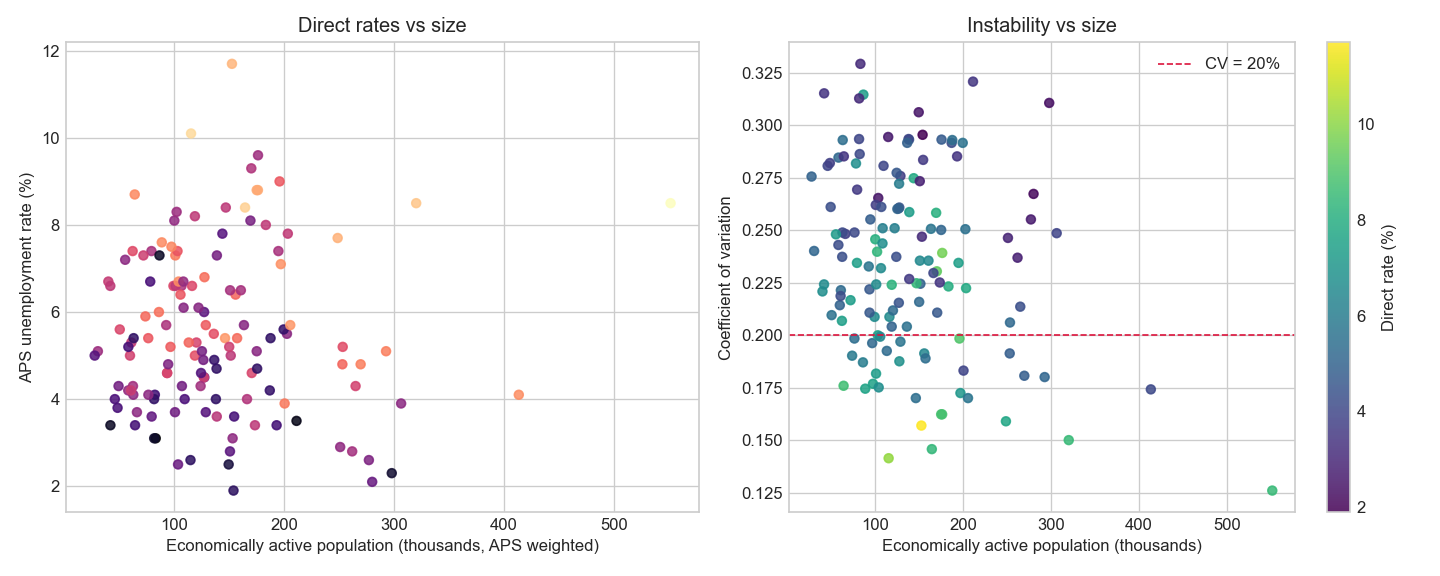
When does the APS local-authority unemployment rate stop being a publication-grade statistic?
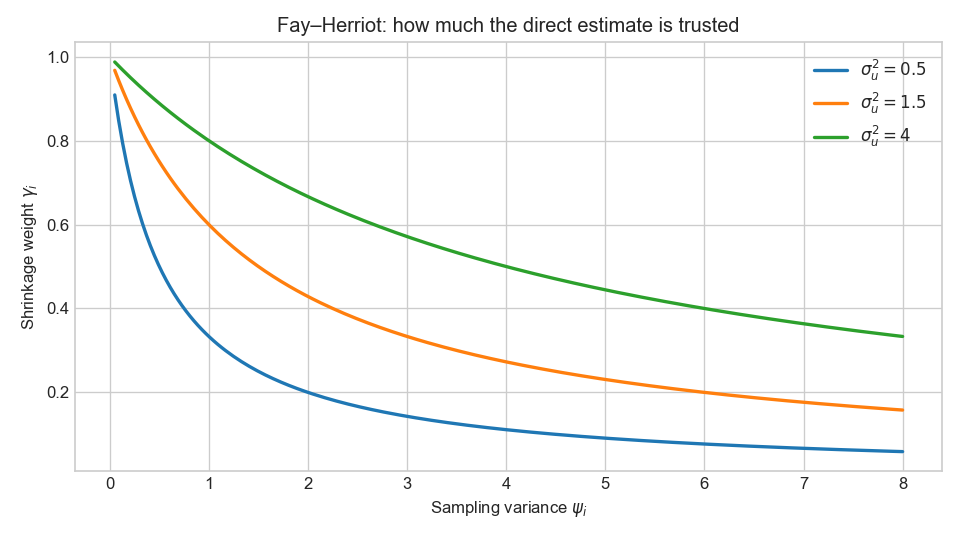
How much should a noisy area shrink toward the claimant-count regression, and does that match ONS?
Do REML EBLUPs and Bayesian posterior means disagree once \(\sigma_u^2\) is uncertain?
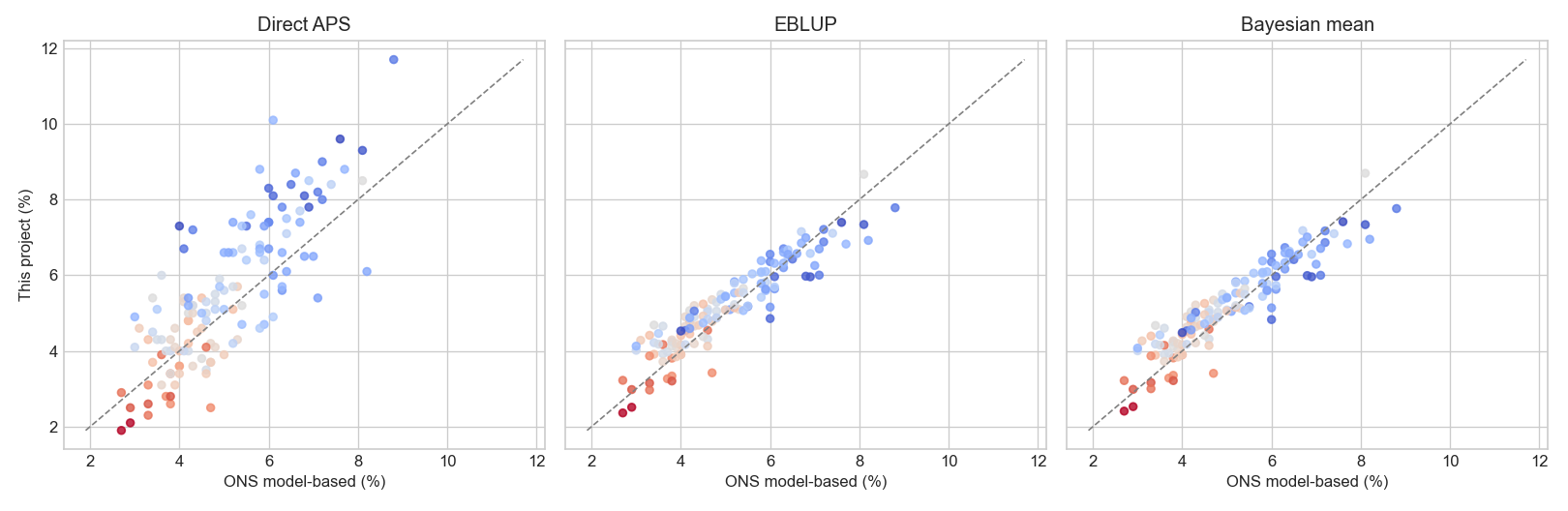
Where do an open Fay–Herriot and the official model-based series diverge — and why might that be expected?
Preview Figures#
Dataset#
Direct estimates: Nomis APS (
NM_17_5, unemployment rate aged 16–64) with published confidence intervalsBenchmark: Nomis model-based estimates of unemployment (
NM_127_1)Auxiliary: Claimant count as % of residents aged 16–64 (
NM_162_1); APS inactivity as a sensitivity covariateBoundaries: ONS Open Geography LAD December 2023 BGC
Licence: Open Government Licence v3.0 — see
data/ATTRIBUTION.txt
Refresh the bundled panel with python projects/small-area-estimation/_build_data.py.
Technical Stack#
Python • Fay–Herriot • REML EBLUP • PyMC • Nomis API • geopandas • Plotly • Official Statistics
Ready to explore?